
After 10 Operations, Teenager Olivia Nguyen Pays It Forward by Volunteering and Raising Awareness of Loeys-Dietz Syndrome

Hoan and Danette Nguyen remember being confused when their daughter, Olivia, “suddenly regressed” after starting to walk right around her first birthday. ““She stopped walking, cried constantly, and was obviously in pain—but of course, she couldn’t tell us what was wrong,” says Hoan.
By the time she went to preschool, Olivia mostly moved around by crawling. Her parents took her to “a bunch” of doctors and eventually she was diagnosed with Polyarticular Juvenile Idiopathic Arthritis. “But because she was so young the doctors knew there must be an underlying cause, so they were trying to dig deeper,” says Hoan.
Eventually, due to effects of various arthritis medications, Olivia was referred to a cardiologist. “It was just me and Olivia at this appointment, and they were taking lots and lots of pictures; they weren’t really telling me anything,” says Danette. “But eventually the doctor came in and said: ‘You need to go see Dr. Hal Dietz at Johns Hopkins – and you need to go now.’”
Things moved quickly after that.
During an echocardiogram, the cardiologist had noted that Olivia, then four years old, had a large aneurysm in her aortic root – a telltale sign of Loeys-Dietz syndrome. In 2005, Dr. Dietz, one of the world’s leading authorities on Marfan syndrome, had worked in conjunction with Dr. Bart Loeys to first observe and then name the genetic aortic and vascular condition. “The cardiologist was very concerned and didn’t know if Olivia needed immediate surgery,” says Danette.
The Nguyens quickly secured an appointment with Dr. Dietz and were grateful for the high-level care they received. “Of course, we went on the Internet and read a lot of scary worst-case scenarios, so it was comforting to be with a professional like Dr. Dietz. He was wonderful,” says Danette.
A genetic test soon confirmed their suspicions: Olivia has LDS. The condition is likely the result of a spontaneous genetic change (sometimes called a mutation that is present throughout a person’s life), as no family members have Loeys-Dietz syndrome. Roughly 75% of the time, LDS is the result of such spontaneous genetic changes. Dr. Dietz confirmed that Olivia would eventually need surgery on her aortic root but cautioned that because she was very underweight – a common LDS symptom – she was too fragile for a major operation. “She was diagnosed with ‘failure to thrive’ at that point and we had to get some weight on her,” says Hoan.
A PD button, a type of feeding tube designed for long-term nutrition support, was installed. “This was not a fun experience for Olivia,” says Danette. “It goes everywhere with you, it leaks and stains your clothes, and sometimes it smells.”
Olivia concurs. “Sometimes acid would come through and it would really burn,” she says. “It also made me too full to eat dinner a lot of the time.”
Olivia lived with the feeding tube for a couple of years. “It was a hard time for the entire family because we had to make the decision to not have her feed at school so she could have a normal school life and be at the cafeteria table with her friends,” says Hoan. “But it meant one of us would have to stay up until 11:00 pm or midnight to hook her up again to the machine. Sometimes we’d have to get up at 4:00 am. She had it on while she was sleeping, which wasn’t very comfortable either. But we all made these sacrifices so she could have a normal life.”
Still, the feeding tube did the trick: Olivia gained enough weight to undergo heart surgery. In 2019 the family headed from their Arlington, Virginia, home to Chicago where Olivia, then nine years old, would undergo surgery on her aortic root. “The surgery lasted for seven or eight hours...and they had to put in a pacemaker, which slowed down her recovery a little bit,” says Hoan.
The week before the surgery the family stayed in a hotel. “We toured all of Chicago and made sure Olivia had some great experiences to brighten her days,” says Hoan.
After the surgery Hoan and Danette spent almost two months living in the local Ronald McDonald House (RMH), which provides free or low-cost “home-away-from-home" services, including housing and meals, to support families with children receiving hospital treatment. It was an experience that would shape how the entire family would come to view Olivia’s LDS diagnosis.
“They always made home-cooked meals for us,” says Olivia, who was mostly in the hospital during this time, but did live with her family in the RMH temporarily. “They had a toy room for all the kids staying there and I even got to take a little drone home with me. There was also another kid there who had LDS and was having the exact same surgery as me, so our families really connected.”
When Olivia returned home she felt a psychological shift. “My entire life I’ve been living with a medical condition, and it was always in the back of my mind that I was different from all my peers. But having the surgery and being able to stay at RMH helped me to connect with other kids who were like me and to know that there were other people going through this, too. At home, I had sometimes felt pretty much alone.”
After the surgery, Hoan and Danette felt mostly relief. “We thought, ‘Okay – now we don’t have to worry so much about something like an aneurysm,” says Hoan. “We knew she now had better odds to have a better life.”
Still, there were more medical concerns ahead. Just a year after the major heart surgery, Olivia had a retinal dissection. (This occurred a couple of weeks after Olivia was “hit hard” in the head by a soccer ball at school, but they can’t confirm that this caused the dissection.) “She was complaining that her eye felt weird and that something was floating in it,” says Danette, adding that they went to an ophthalmologist who scheduled immediate surgery. Unfortunately, the surgery was not successful and Olivia ultimately lost vision in her left eye.
A year later, when the ophthalmologist noticed some tears forming in her right eye they proactively performed an operation to insert a scleral buckle, a silicone band that is attached to the outside of the eye to prevent retinal detachment. “When she got back from the surgery on her right eye, the good eye, she was basically temporarily blind. So we had to feed her and take care of everything,” says Hoan. “It was pretty devastating. It’s always in the back of our minds: how can we protect her remaining eye to make sure that she can always see?”
Being hit in the head with the soccer ball, and the subsequent loss of sight in one eye, helped Olivia come to terms with her athletic limitations. “When I was younger, I was constantly questioning why I couldn’t participate. During field day the whole school would play together, and I’d have to sit out,” she says. “I was devastated. But now I understand my condition more and I know what I can and can’t do. It’s okay.”
These days, Olivia, now 16, who is a junior in high school, is focusing on academics – “Chinese is my favorite subject” – playing guitar, and volunteering at two local Ronald McDonald Houses. Danette and Olivia love preparing balanced home-cooked meals for other families. “I was previously in their shoes and I know how comforting it is to have a good meal. I just want to help the kids who are undergoing medical procedures like mine to feel at home. I play with them and try to make sure they’re having some fun. I want them to know they’re not alone.”
Adds Olivia: “Sharing my lived experiences also heals me.”
Olivia was recently honored with a Point of Light Award, a national program started in 1990 by President George H.W. Bush that recognizes outstanding volunteers.
Danette says that Olivia’s volunteer work has had a positive affect on her. “I have seen a new confidence in her. Maybe it's because she’s older and much more knowledgeable about her LDS. There were days you would never see her in a shirt that wasn't a crew neck or a turtleneck because of the large scar on her chest. But now? She’ll go to dances and wear tube tops; she doesn’t care if her scar shows. LDS used to be her little secret – but not anymore.”
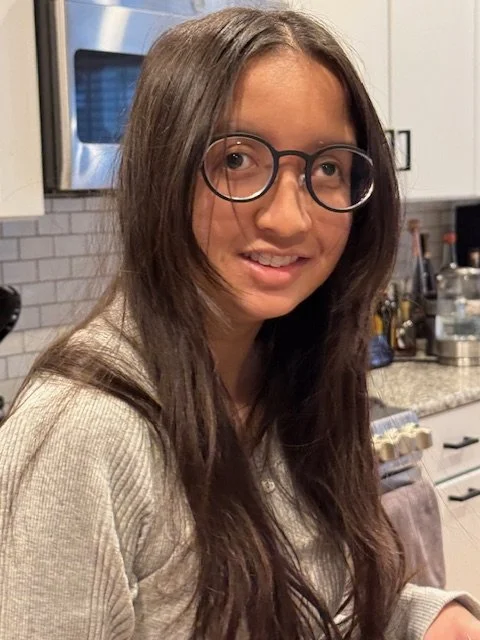
Basically, Olivia aims to “widen the circle of people who know about LDS. When I was growing up, nobody knew that I had LDS – not friends, not my classmates, not even my teachers. I want them to know that yes, people with LDS might not be able to do as many physical things as you, but we’re still regular people.”
Adds Hoan: “It's all about diagnosing early enough so you can treat it right. Monitoring is a key part of LDS, especially monitoring the heart with annual visits.”
As Olivia ponders the future, she notes that she is considering becoming a doctor. “I’ve met so many doctors; some are great, some don’t have a good bedside manner. I think I’ve learned how to treat kids in the hospital; it’s so important.”